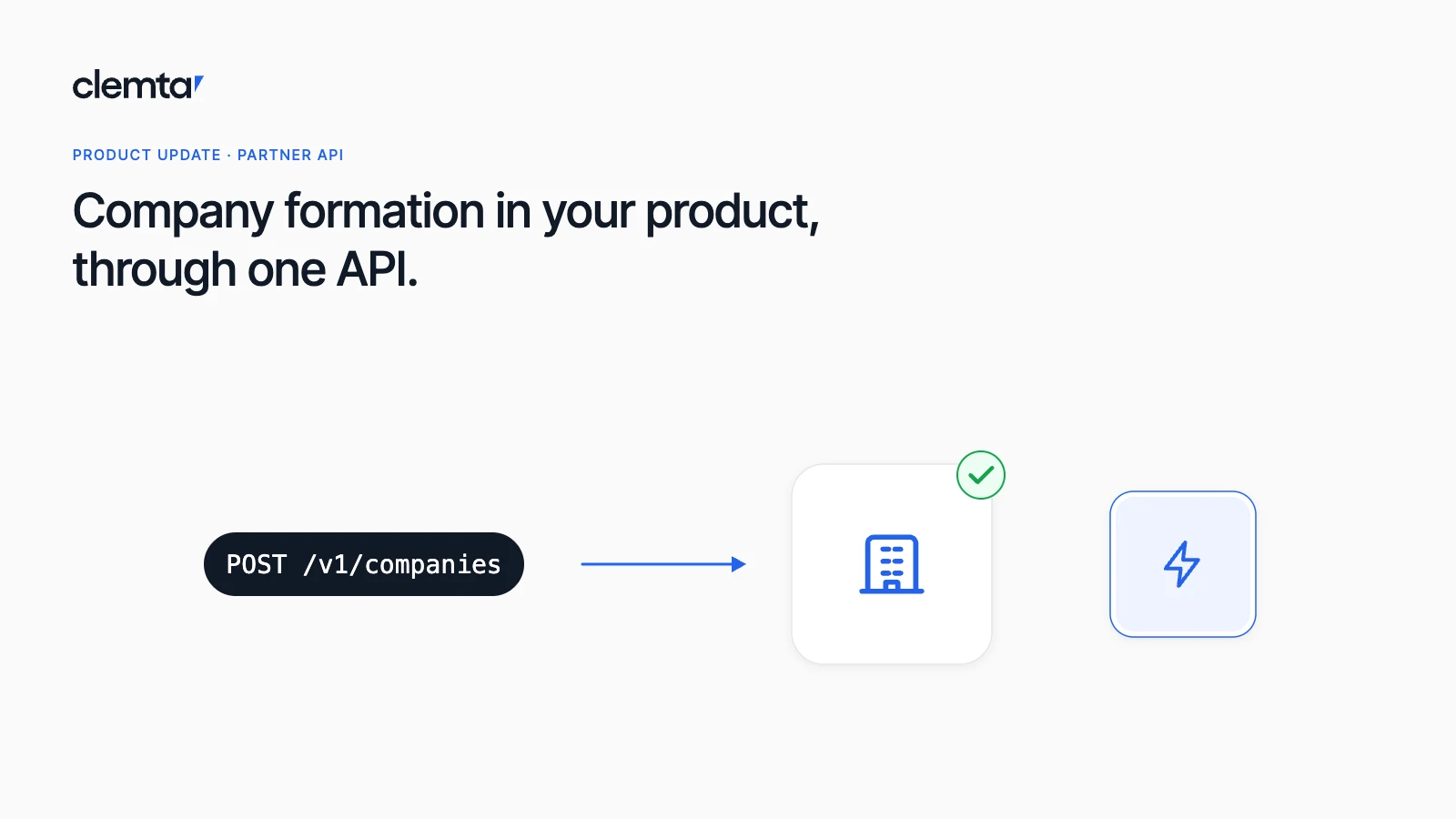
Your users need a US company. Don't send them elsewhere. That line has been on our Whitelabel Program page for a while, and partners have been sending us formation orders through the Partner API for just as long. The first version did one job: it took a company's formation details into Clemta and let you read the status of that formation. Everything after formation, the EIN, the documents, the filings and the invoices, happened outside the API. Today we are shipping the biggest update the Partner API has had. A platform can now offer formation, compliance and tax filings at its own prices, inside its own product, and Clemta does the work and invoices it once a month.
From formation orders to the whole lifecycle

The first Partner API was a formation API: three endpoints to initiate a formation, retrieve its status and cancel it, with an API key provisioned by Clemta. It worked, and partners built on it, but it stopped where the real work starts. Once the company existed, your customer's EIN, documents, annual filings and services were out of your product's reach, and you only learned about progress when you asked.
The update replaces that one-way exchange with the whole lifecycle:
The first Partner API | Today's update | |
|---|---|---|
Scope | Formation orders: create one, read its status, cancel it. | The whole company: formation, identity verification, EIN, requirements, documents, service orders, tax filings, the compliance calendar and invoices. |
Direction | You sent the details and asked for the status. | Every change reaches you as a signed webhook event, and the same data is there on request. |
Keys | One API key, provisioned by Clemta, sent as a header on every request. | Test and live keys with scopes, rotation, revocation and IP allowlists, which you manage yourself in the partner dashboard. |
Versions | One version, | Dated versions pinned per request with the |
Your customer | A formation customer of Clemta, referred by you. | Your customer, whitelabel: no Clemta emails, no Clemta login, your brand on every hosted page. |
If you integrated the first version, write to [email protected] and we will plan the move with you. The rest of this post walks through what the Partner API does now.
How it fits together
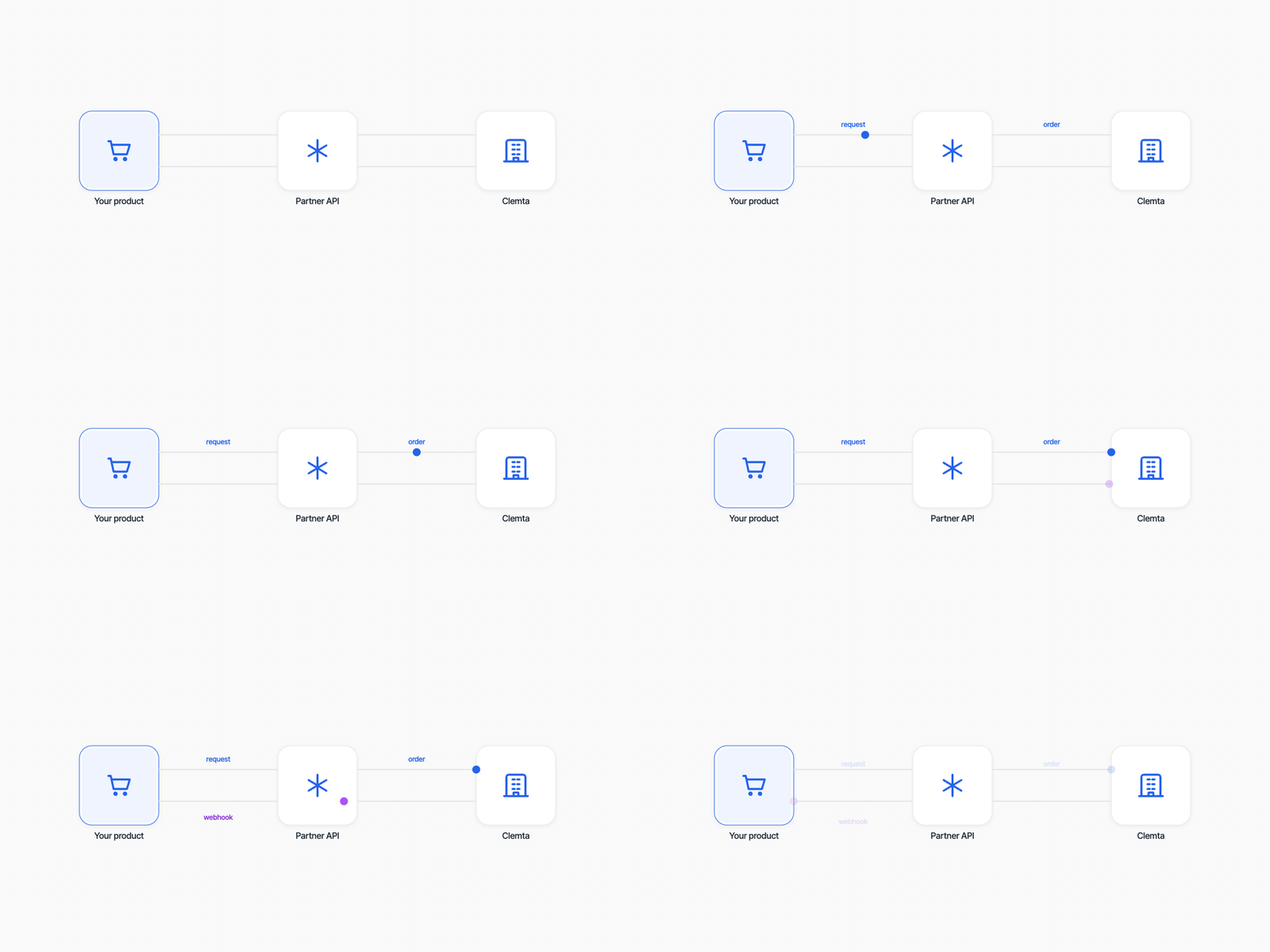
Three parts, and you never leave your own product. Your customers sign up, order and pay you. The Partner API puts companies, orders, files and filings behind one key. Clemta Operations does the formation, EIN, filings and compliance work. One call creates the client and the company shell. Attach services such as EIN or bookkeeping with a second call, and follow every step through webhooks.
Everything a partner needs, as endpoints

The same catalog Clemta sells directly, exposed to you at partner prices. Everything in it that is enabled for your partnership is available as an endpoint:
- Companies and accounts. Create a client account and company in one call, with your own ID. Clemta never contacts your customers.
- Products at your prices. List the products you can sell at your partner rate, with bundles like registered agent and EIN: formation, EIN, ITIN, bookkeeping, tax filings, trademarks, business address and post-incorporation services.
- Service orders. Attach products to a company or accept a quote. A repeated order returns the existing one, never a second bill.
- Requirements and hosted links. See what Clemta needs, fulfill it through the API, or send your client a hosted link.
- Identity verification. Your customer uploads their ID on a hosted page in your brand. You never handle the files.
- Files and deliverables. Download formation documents, EIN letters and every deliverable, or share file links.
- Tax filings and calendar. Create, track and submit tax filings, and read each company's compliance calendar.
- Status links for your customers. A revocable link per company shows live progress inside your product, no API key needed.
- Webhooks and events. Subscribe to company, order, filing and invoice events, or page through the event stream.
One call creates a company

A single request creates the account, the company and the services on it. The quickstart call is POST /v1/companies with a test key: the company name, state and entity type, the account holder, the shareholders with their ownership and address, and the services you want on day one, such as ein. Send an Idempotency-Key with it and a retried request never forms two companies.
The company comes back in requires_information: each owner still owes an identity document. Attach it from your side, or create a verification session and forward the hosted link to your customer. Once every owner's document is in, the company moves on, and you hear about each step as an event.
Your customer stays yours
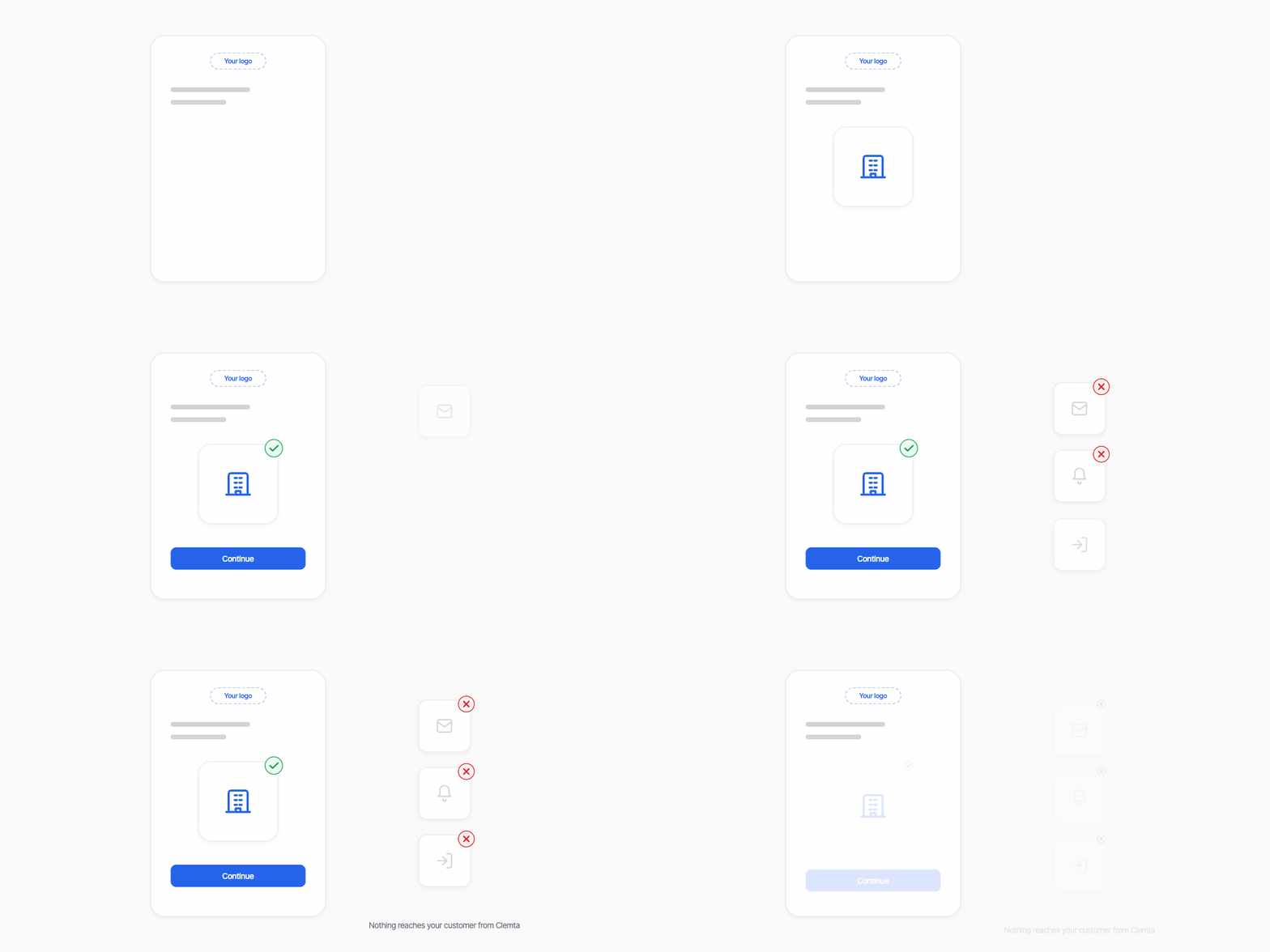
Every company you create is whitelabel. Your customers deal only with you. This is the one rule behind every design choice in the API:
- No emails, no SMS and no push notifications from Clemta to your customer, on any channel.
- No Clemta login. The owner never becomes a Clemta user. Their contact details live on your account object, not ours.
- Your name, logo and colors on the pages Clemta hosts for them: identity verification and document signing.
Clemta's operations team does the formation, filing and compliance work, and everything your customer would need to hear reaches you as an event, so you can say it in your own voice from your own domain.
The moment | The event you receive |
|---|---|
The company is incorporated |
|
The EIN is assigned |
|
An owner's ID is needed |
|
A form is needed for a fulfillment step |
|
A document is ready |
|
A service moves forward |
|
Your monthly invoice is issued |
|
Your customers can still follow their order. Create a status link for each company: it returns live progress only, without documents, personal data or prices, so you can show a progress view in your own product.
A sandbox that behaves like production
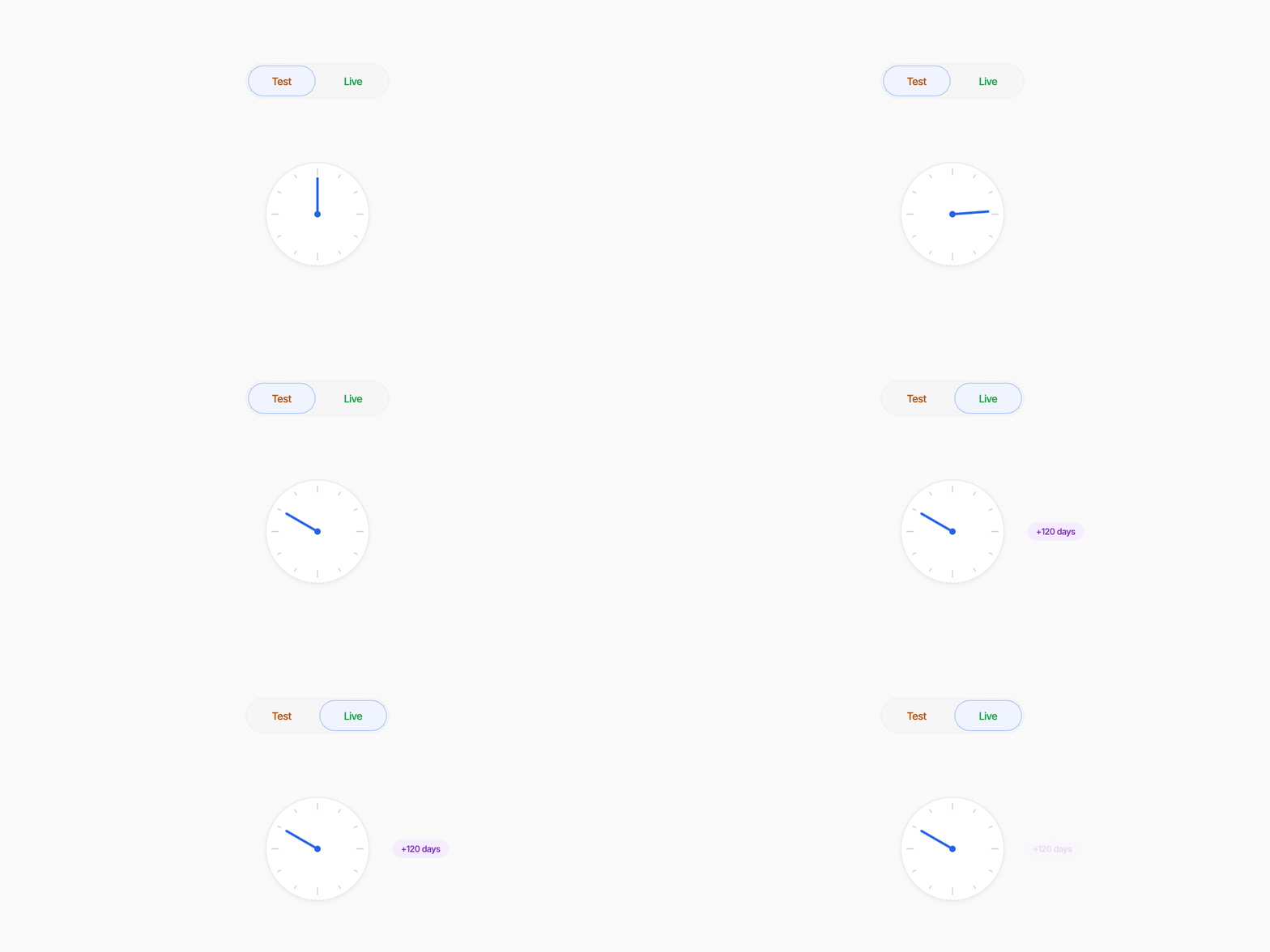
Test keys run in sandbox mode against the same API. Every key is either live or test, and everything a key touches inherits its mode. A clmt_test_ key runs the whole surface: companies, orders, requirements, files and tax filings all exist and every event fires, but nothing in sandbox reaches fulfillment or billing.
A test company never advances on its own, because Clemta is not fulfilling it. You simulate Clemta's work yourself with one call that names the event and applies the change exactly as a live one would, once-only rules included. Move a test company to active, and company.incorporated arrives at your test endpoint the way it will in production.
Renewals, deadlines and reminders depend on time passing, so test mode also has a clock you can move forward. Advance it and rehearse renewals and deadlines before they happen for real. A test key is never billed.
Designed to be relied on

The conventions you expect from a payments-grade API, so your integration stays stable as Clemta evolves:
- Idempotent and versioned. Send an
Idempotency-Keyto retry safely: a timed-out company creation never forms two companies. Pin the API version by date with theClemta-Versionheader. Non-breaking changes land under the version you pin, and a change to a resource's shape ships as a new dated version. The current version is 2026-08-13. - Signed webhooks. Deliveries follow the Standard Webhooks spec with signed payloads, are retried with backoff over several days, and are paced per endpoint so one failing event does not block the rest.
- Clear rate limits. Every response carries
RateLimitheaders so your client can back off before it is throttled. - One error envelope. Every error carries a machine-readable code and a
request_idyou can quote to support. - Test and live keys. Scoped keys for sandbox and live mode, rotation with a grace window, and IP allowlists managed in the dashboard.
Partner prices, one invoice a month

You pay your partner price for each order, renewal or accepted quote, on one invoice a month. There is no subscription and no up-front commitment. A recurring product renews at the price captured on the order, so a later price change never touches a running service. A quoted product is charged only when you accept the quote, and an order cancelled before work starts is credited in full.
At the end of each month, the charges and credits roll into one statement. Once reviewed, it is issued as an invoice and collected automatically from the payment method on file. You bill your users at your price; every order lands as a line on your month-end invoice at your partner rate. The Billing page of the dashboard shows every invoice, each statement line by line, and a running usage ledger you can filter by company or product.
Run the partnership from one dashboard
Everything that is not an API call happens at partner.clemta.com:
- API keys for test and live mode, with scopes, rotation, revocation, IP allowlists and last-used times.
- Webhooks registered per mode, with the signing secret, 30 days of deliveries with their payload and response, and a retry for one delivery or a whole backlog.
- Logs of every API and dashboard request for 30 days, searchable by request ID.
- Partner MCP. Ask about your companies in plain words, from Claude, Cursor or any MCP client. It has a post of its own.
- Billing and usage: one statement a month with every line item, invoices, the usage ledger and your payment method.
- Partner pricing: your price sheet, and every change for you to accept or decline.
- Team and roles: one owner and any number of members. Members build in test mode; live keys, webhooks, branding and pricing stay with the owner.
- Branding and settings: your name, logo and colors on the pages we host, and the origins allowed to embed them.
Built with coding agents in mind
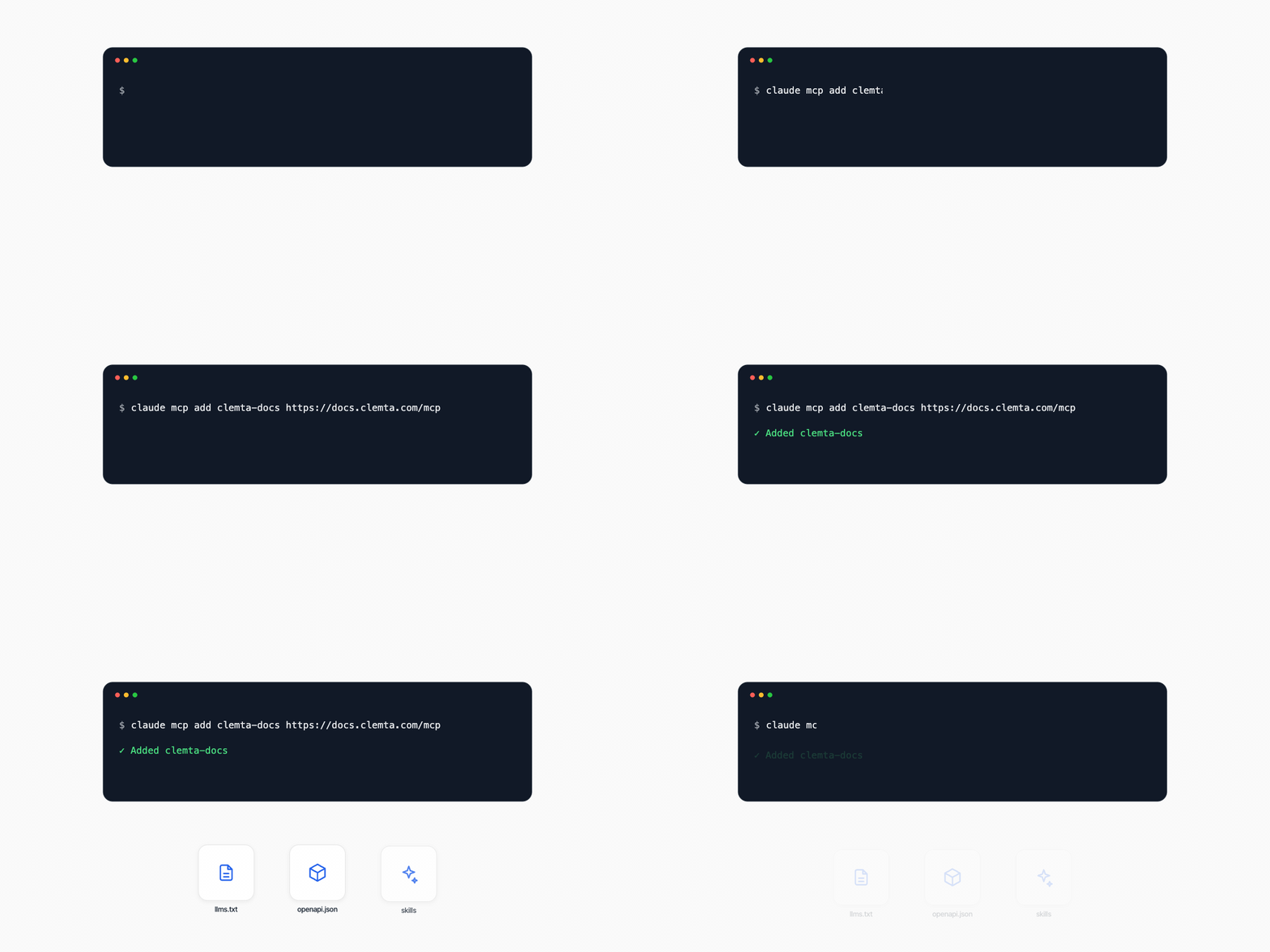
Most integrations will be written with a coding agent at the keyboard, so the docs are built for one. Skills carry the request rules and the sandbox into Claude Code, Cursor and the rest. A docs search server runs at docs.clemta.com/mcp. Every page is available as Markdown, the whole site fits in one llms.txt file, and the OpenAPI description is served from the API without a key.
From application to your first live company
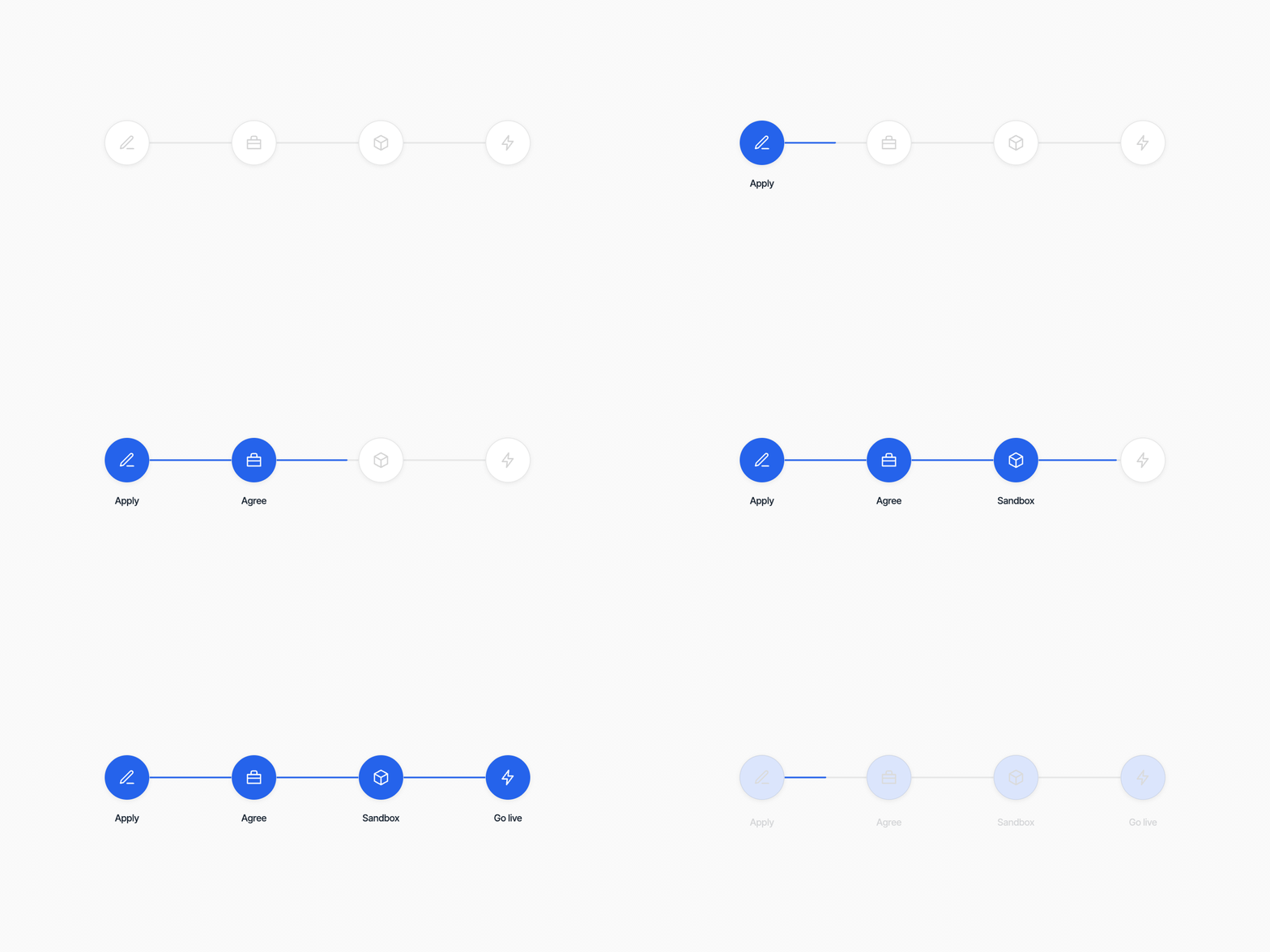
There is no public signup. Four steps, and you never leave your own product:
- Apply. Open a workspace on the partner dashboard and tell us about your company, your use case and the volume you expect. We review every application and come back with next steps within 1 business day.
- Agree on terms. You receive the partner agreement and your customized price book. Upon your confirmation, your sandbox keys are issued.
- Build in the sandbox. Run a test company with your test keys. Advance the test clock to rehearse renewals and deadlines before they happen for real.
- Go live. Swap in your live keys and form your first company.
Start with the Partner API docs or the Whitelabel Program page. Questions, and moves from the first version, go to [email protected].

Ready to whitelabel Clemta?
Apply for API access and start building in the sandbox this week.

Barbaros Bayram
Chief Product Officer at Clemta