The Short Answer
Form 1120 is the U.S. Corporation Income Tax Return. Every domestic C Corporation files it once a year to report its income, deductions and federal tax — including corporations that earned nothing, lost money, or never started trading. An LLC that made an entity classification election to be taxed as a corporation files the same return. It is due on the 15th day of the fourth month after the corporation's tax year ends, and Form 7004 extends the filing deadline by six months. Foreign-owned US corporations normally attach Form 5472 to it.
What Is Form 1120?
A C Corporation is a separate taxpayer. Unlike a partnership or a single-member LLC, it does not push its profit down to the people who own it — it calculates its own taxable income and pays its own federal tax. Form 1120 is the document where that calculation happens.
That separation is the reason people talk about double taxation: the corporation is taxed on its profit, and the shareholders are taxed again when that profit is paid out as dividends. Form 1120 covers only the first half of that. The shareholder side is handled on their own personal returns.
The filing obligation follows the entity, not the activity. Once a corporation exists, the return is due every year until the company is formally closed with the state and a final return is filed. A dormant company with an empty bank account still files. This is the single most common misunderstanding among founders who incorporate early and start operating later.
Who Must File Form 1120?
Domestic C Corporations
Any corporation formed under the law of a US state and treated as a C Corporation for federal purposes files Form 1120. Delaware, Wyoming, Nevada, Texas — the state of formation does not change the federal form. Profit, loss and zero activity all lead to the same return.
LLCs That Elected Corporate Taxation
An LLC is not a tax classification. By default, a single-member LLC is a disregarded entity and a multi-member LLC is a partnership. But an LLC can file an entity classification election and ask to be taxed as a corporation instead. From that point on it files Form 1120 like any other C Corporation, even though its legal wrapper is still an LLC. Founders who are choosing between an LLC and a C Corporation should understand this before they file anything, because the election is easy to make and awkward to undo.
Foreign-Owned US Corporations
A US corporation owned by non-residents is still a US taxpayer. Being a foreign-owned US entity does not remove the Form 1120 obligation — it adds to it, because Form 5472 usually has to be attached to the same return.
Who Does Not File Form 1120
S Corporations file Form 1120-S. Partnerships and multi-member LLCs that never elected corporate treatment file a partnership tax return instead. A single-member LLC treated as a disregarded entity reports on its owner's return — although a foreign-owned one still carries a separate reporting duty of its own. Non-profits and certain specialised entities have their own dedicated forms.
Form 1120 vs the Other Business Tax Returns
Return | Who files it | Tax paid at | Owner reports |
|---|---|---|---|
Form 1120 | C Corporations | Company level | Dividends received |
Form 1120-S | S Corporations | Owner level | Share of profit |
Form 1065 | Partnerships, multi-member LLCs | Owner level | Share of profit |
Schedule C | Sole proprietors, disregarded LLCs | Owner level | All profit |
Form 1120-F | Foreign corporations with US income | Company level | Not applicable |
The practical takeaway: pass-through taxation moves the tax bill onto the owners' personal returns, while Form 1120 keeps it inside the company.
What Form 1120 Actually Asks For
Income. Gross receipts, returns and allowances, cost of goods sold, and any other income the corporation received during the year.
Deductions. Salaries, rent, professional fees, advertising, depreciation, interest and the other ordinary business expenses. This is where clean bookkeeping either saves you money or costs you money.
Tax and payments. Taxable income is calculated, the federal corporate rate is applied, credits are subtracted, and anything already paid in through estimated tax payments during the year is credited against the balance.
Balance sheet and reconciliation. Larger corporations attach a balance sheet drawn from their books and reconcile accounting profit to taxable profit. Smaller corporations are often relieved from parts of this, but the underlying numbers still have to exist somewhere.
Ownership and other information. The return asks who owns the corporation, whether it owns other entities, which accounting method it uses, and what its business activity is.
We are deliberately not walking through the form line by line. Line numbering shifts between years, and a founder copying last year's walkthrough into this year's form is more likely to make an error, not less. What matters is that the five blocks above are supported by real books.
Schedules and Attachments Filed With Form 1120
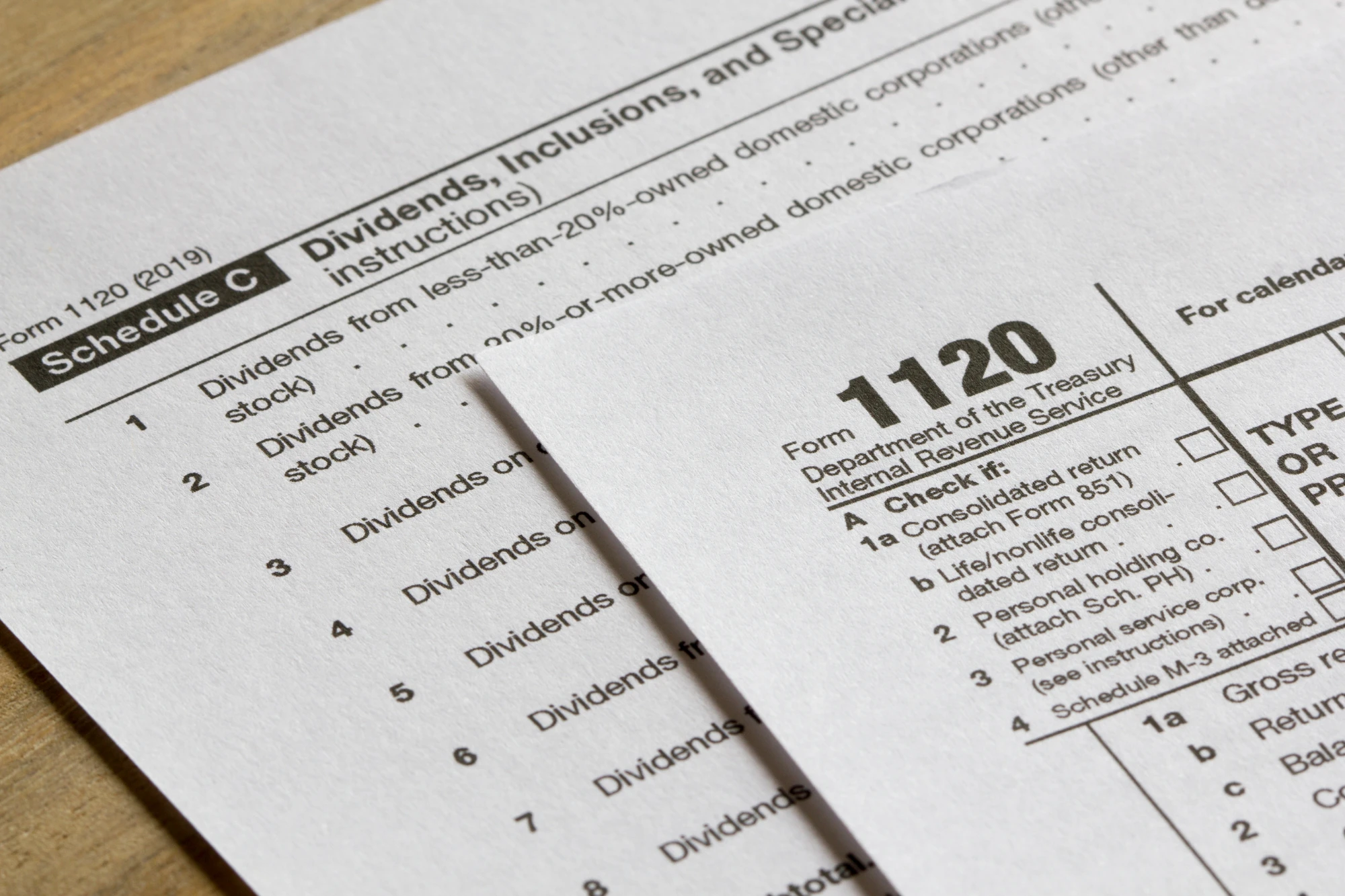
Form 1120 is a short form with a long tail. The most common companions are Schedule C for dividends the corporation received, Schedule J for the tax computation and credits, Schedule K for general information about the corporation, Schedule L for the balance sheet taken from the books, and Schedules M-1 and M-2 for the bridge between book profit and taxable profit and the movement in retained earnings. Corporations selling physical products usually add Form 1125-A for cost of goods sold, and foreign-owned corporations add Form 5472.
Which ones apply depends on size, ownership and activity. Most small non-resident-owned corporations file a short stack; the burden grows as the balance sheet grows.
Form 1120 Deadlines And Extensions
The return is due on the 15th day of the fourth month after the end of the corporation's tax year. For the overwhelming majority of companies, which use the calendar year, that lands in the spring.
Form 7004 extends the filing deadline by six months. It is close to automatic — you do not have to justify the request — but it extends the time to file, not the time to pay. If the corporation owes tax, that money is still expected by the original date, and interest runs from there regardless of the extension.
Corporations that expect a meaningful bill also pay during the year rather than in one lump sum at filing. Missing those instalments creates a separate charge of its own, which is why the quarterly rhythm deserves a place in the calendar instead of being treated as an afterthought.
Form 5472: The Extra Return for Foreign-Owned Corporations
If a US corporation is at least 25% foreign-owned, it generally has to report its transactions with related foreign parties on Form 5472, filed together with Form 1120.
"Reportable transactions" is a broader category than most founders expect. Money the owner puts into the company, money the company sends back out, loans, management fees, and payments to a related company abroad all count. A corporation with no customers and no revenue can still have a Form 5472 obligation purely because the founder funded it.
The penalty regime here is aggressive, applies per form and per year, and is not reduced by the fact that no tax was owed. Non-resident founders should treat Form 1120 and Form 5472 as one job, not two.
How to File Form 1120
The return can be filed on paper or electronically, and corporations above certain size thresholds are required to file electronically. Electronic filing is faster to confirm and leaves no room for a lost envelope.
Payment is separate from the return. Federal corporate tax is normally paid through EFTPS rather than sent with the form. Enrolment in that system is not instant, so it is worth setting up well before the first payment is due rather than in the week of the deadline.
Whatever the method, the corporation needs an Employer Identification Number before it can file anything at all. If the EIN was never issued, or the confirmation letter was lost, that is the first problem to solve.
What Happens If You File Late
Late filing and late payment are charged separately, and both are calculated on the tax due. A corporation with no tax due still faces the real consequence of a missing return: an open compliance gap that surfaces later, usually at the worst possible moment — during a bank review, a funding round, an acquisition, or when the company tries to close.
Form 5472 is harsher still, because its penalty applies even when nothing is owed. That is precisely the situation most early-stage foreign-owned corporations are in.
Ignoring the return does not make the obligation disappear, and it does not stop the state-level clock either. A Delaware corporation that skips its federal return has usually also skipped its Delaware franchise tax, and the two problems compound quietly until they are expensive.
Filing Form 1120 as a Non-Resident Founder
Nothing about non-residency exempts a US corporation from Form 1120. What changes is the work around it. Form 5472 almost always applies. Books have to be kept in US dollars on a consistent basis, usually accrual basis accounting once there are receivables and payables. A real balance sheet has to exist, not just a bank statement. State obligations run in parallel on their own deadlines — the annual costs of a Delaware C Corp are not covered by the federal return. And if the founder takes money out of the company, that payment can carry withholding duties of its own.
Founders who set this up in the first year rarely have trouble in the second. Founders who wait until the deadline of year two usually pay twice: once for the filing, and once for reconstructing a year of records.
Common Form 1120 Mistakes
Assuming no revenue means no return. It does not. Treating the extension as a payment extension. It is not. Filing Form 1120 for an LLC that never made an election — without that election the LLC is a disregarded entity or a partnership, and the wrong return creates a mismatch that takes months to unwind. Forgetting Form 5472, which is the most expensive omission on this list. Filing the federal return and stopping there, when the state return and the annual report are separate obligations. And reconstructing the books in the final week, when every number on Form 1120 is supposed to come out of a ledger that already existed.
Frequently Asked Questions
Do I have to file Form 1120 if the corporation had no income?
Yes. The obligation attaches to the corporation's existence, not to its revenue. A zero return is still a return, and filing it costs far less than explaining the gap later.
What is the difference between Form 1120 and Form 1120-S?
Form 1120 is for C Corporations, which pay tax at company level. Form 1120-S is for S Corporations, which pass profit through to their shareholders. S Corporation status is not available to non-resident owners, so most internationally owned US corporations file Form 1120.
Can an LLC file Form 1120?
Only if it filed an election to be taxed as a corporation. Without that election, an LLC files as a disregarded entity or as a partnership instead.
Does an extension give me more time to pay?
No. Form 7004 extends the filing deadline only. Tax owed is still due on the original date, and interest accrues from that date forward.
Do I still file if the corporation was dissolved?
Yes. A final return is required for the year the corporation ceased operations, and there are other loose ends to close after dissolving a corporation beyond the tax return itself.
Does filing Form 1120 cover state taxes too?
No. Form 1120 is federal only. Most states require their own corporate return, franchise tax filing or annual report, on their own schedule.
Form 1120 is not a difficult form to file. It is a difficult form to file correctly from bad records. If your US C Corporation is approaching its federal deadline, Clemta's federal tax filing service prepares and files Form 1120 and Form 5472 together, and our bookkeeping team maintains the ledger those numbers come from. State-level obligations are handled through state tax filing, and everything else that follows incorporation sits under post-incorporation support.

Begüm Tekin
Tax Operations Manager at Clemta