The Short Answer
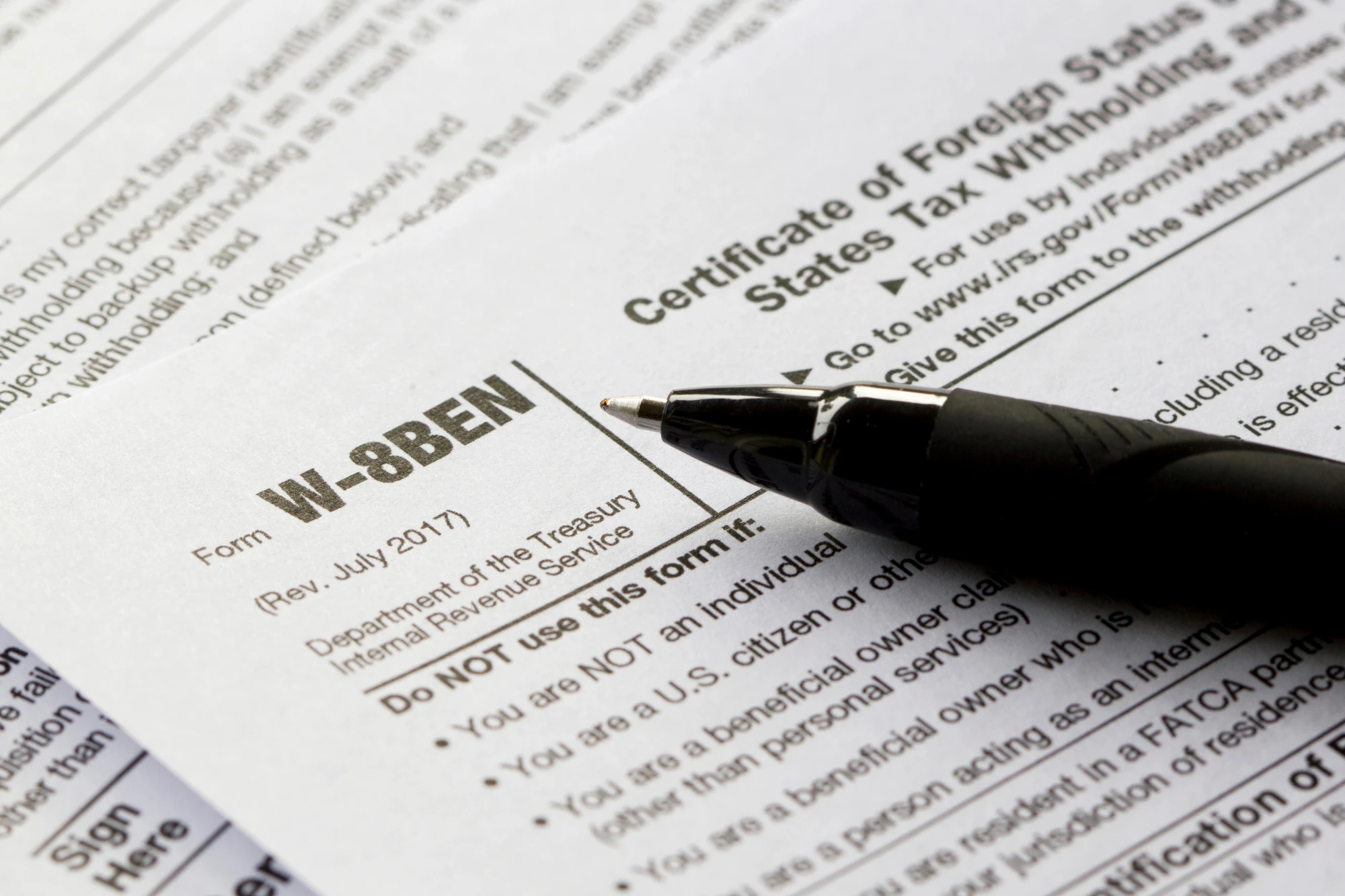
A W-8 form is how a non-US person tells a US payer: I am not a US taxpayer, so do not withhold at the default rate on what you pay me. Individuals use Form W-8BEN. Foreign companies use Form W-8BEN-E. The form never goes to the IRS — you hand it to whoever is paying you, and they keep it on file. If you formed a US LLC, the answer flips: a US entity generally provides Form W-9 instead, and the exception is a single-member LLC with a foreign owner, where the owner supplies the W-8 on the entity's behalf.
What a W-8 Form Actually Does
US law starts from a blunt assumption. When a US business sends money abroad — a payment for services, a royalty, a dividend, interest — it is required to assume the recipient is subject to withholding unless the recipient proves otherwise. The payer becomes the withholding agent, and if it gets this wrong, the IRS collects from the payer, not from you. That is why your client's finance team is asking for paperwork before they release an invoice.
The W-8 series is that proof. By signing it you are certifying three things: who you are, what country you are a tax resident of, and that you are not a US person. If a tax treaty between your country and the United States gives you a better rate, the W-8 is also where you claim it.
Two consequences follow that people rarely think about. First, the form is a certification, not an application — nobody approves it. Second, because your client is legally exposed if the certification is wrong, they will often be stricter than the IRS would be. A rejected W-8 is usually a client's compliance officer being cautious, not a tax problem.
W-8BEN vs. W-8BEN-E: The Difference in One Table
The two forms look similar and share a name, but they are not interchangeable. The distinction is simply whether the beneficial owner of the income is a human being or an organisation.
Criterion | Form W-8BEN | Form W-8BEN-E |
Who signs it | An individual | An entity — company, partnership, trust |
Typical user | Freelancer, consultant, contractor, author, investor | Foreign LLC, GmbH, Ltd, SARL, AŞ |
Length | Short, one page | Substantially longer, multiple parts |
Tax ID expected | Foreign tax number or a US ITIN | Foreign tax number or a US EIN |
Treaty claim | Yes, in a dedicated section | Yes, plus an entity classification |
Hardest part | Getting the residence country right | Classifying the entity correctly |
The practical gap is the classification. An individual filling out a W-8BEN is describing a person, and there is only one kind of person. An entity filling out a W-8BEN-E has to state what kind of entity it is for US tax purposes, and that answer does not always match what the company is called at home. This single question is where most W-8BEN-E forms get bounced back.
Which Form Applies to You
You Are a Freelancer Paid by a US Client
You live outside the United States, you invoice a US company for design work, development, writing or consulting, and you have no US entity. You are an individual receiving foreign-source income for services performed abroad. Form W-8BEN is the correct form. You will need either a tax identification number from your own country or a US ITIN, and if your country has a treaty with the US you can reference it.
You Own a US LLC and Your client Asks for a Form
This is the case that trips up almost everyone Clemta works with. Your Delaware or Wyoming LLC is a US entity. A US entity does not file a W-8 — it generally provides Form W-9, because it is a US person for this purpose. That is true even though you, the owner, are not American.
The exception matters, though. A single-member LLC is by default a disregarded entity, which means the IRS looks through the company to its owner. When the owner of a US disregarded entity is a foreign person, the certification has to come from that foreign owner on the appropriate W-8, with the LLC identified as the disregarded entity. So the same company can end up on a W-9 or behind a W-8 depending on how it is classified and who owns it. Before you send anything, confirm how your LLC is actually classified — a single-member LLC that elected to be taxed as a corporation is a different answer again.
Your Non-US Company Invoices a US Business
You operate a limited company, GmbH, AŞ or SARL outside the United States and it bills American clients. Form W-8BEN-E is the one, signed by someone authorised to bind the company. You will be asked to classify the entity and, if you want treaty benefits, to identify the specific article you are relying on. If the company has US-source income of the kind that gets reported, you will usually also need a US EIN — a foreign entity can obtain one without forming a US company.
W-8 vs. W-9. Which One Does Your Client Actually Need?
Both forms answer the same question for the payer — do I have to withhold and report on this payment — from opposite directions. Form W-9 says "I am a US person, here is my taxpayer identification number." A W-8 says "I am not."
Clients get this wrong constantly, and there is a predictable reason. Their accounts payable system sees a US address, a US bank account or a US company name and defaults to a W-9. If you are a non-resident with a US LLC and a US business bank account, you look American to their software. Conversely, if you are a US citizen living abroad, you may be sent a W-8, and that is also wrong: US citizens and green card holders remain US persons regardless of where they live, and they file the W-9.
The useful rule is that the form follows tax status, not geography. Where you live, where your bank is and where your customers are do not decide it. Whether you are a US person for tax purposes does.
The Rest of the W-8 Family
W-8BEN and W-8BEN-E cover most situations, but there are three more forms in the series, and knowing they exist saves you from forcing your case into the wrong one.
Form W-8ECI is for income that is effectively connected with a US trade or business. If your income is genuinely tied to US business operations, it is taxed on a net basis through a return rather than withheld at source, and this is the form that says so.
Form W-8EXP is for foreign governments, central banks, international organisations, and certain tax-exempt foundations. Ordinary companies never need it.
Form W-8IMY is for intermediaries — entities receiving payments on behalf of someone else, such as certain partnerships, nominees and flow-through structures. If money passes through you to the real owner, you are likely in W-8IMY territory rather than W-8BEN-E.
If you are reading this because a client sent you a request, the odds are overwhelming that you
need W-8BEN or W-8BEN-E. The others are worth recognising precisely so you can rule them out.
Who You Give the Form To (and Who You Never Sent It To)
Do not mail a W-8 to the IRS. It is not filed with a tax return and there is no submission portal for it. You give it to the withholding agent — the client, marketplace, platform, broker or bank that is paying you — and they retain it as their justification for how they treated the payment.
Most large platforms collect it electronically inside their payout settings rather than as a PDF, which is why the experience differs so much from one payer to the next. What happens next is invisible to you: your payer reports the payment and any amount withheld on an information return, and if tax was withheld, that document is your evidence when you claim it back.
How Long a W-8 Stays Valid
A W-8 does not last forever. It generally remains valid until the end of the third full calendar year after you sign it, and then expires. Your payer is supposed to ask for a fresh one, but many do not notice until the payout stops.
It also becomes invalid the moment any fact on it changes — a new address, a change of tax residence, a new legal name, a change in entity classification. Practically speaking, the two things worth doing are diarising the expiry when you sign, and re-sending a form whenever your company details change rather than waiting to be asked. An expired W-8 is treated the same as no W-8 at all.
What Withholding Actually Costs You
Without a valid W-8 on file, the payer withholds at the statutory default rate on payments that are subject to withholding, and that money leaves before you ever see the invoice total. Recovering it is possible but slow: you file a US return for the year, attach the information return showing the amount withheld, and wait for a refund that is measured in months.
The compounding cost is relational. Withheld payments create reconciliation problems for both sides, and a client who has had one messy payout tends to become reluctant about the next contract. Fixing the paperwork before the first invoice is cheap; fixing it afterwards involves a tax filing.
Five Mistakes That Get a W-8 Rejected
Using a mailing address as the country of residence. The form asks where you are tax resident, and a friend's address, a virtual office or a US mail forwarding service is not an answer. A mismatch here is the fastest route to rejection.
Signing the wrong form for your structure. An individual signing a W-8BEN-E, or a company signing a W-8BEN, will be sent back regardless of how carefully the rest is completed.
Claiming a treaty benefit without the residence to support it. A treaty claim rests on being a tax resident of the treaty country, not on holding its passport. If you have moved, the claim moves with you.
Leaving the tax identification number blank. Some claims cannot be honoured without either a foreign tax number or a US one, and a blank field means the payer applies the default treatment.
Letting the signature go stale. An unsigned, undated, or expired form is not a form. Check the date before you send it and again three years later.
Frequently Asked Questions
Do I need an ITIN or an EIN to file a W-8?
Not always. In many cases your own country's tax identification number is sufficient. A US number becomes necessary in specific situations, including certain treaty claims and certain types of income — individuals would need an ITIN, entities an EIN.
My US LLC has one owner and it is me, a non-resident. W-9 or W-8?
It depends on how the LLC is classified. A single-member LLC is disregarded by default, and where the owner is foreign the certification generally comes from the owner on the appropriate W-8 with the LLC named as the disregarded entity. If the LLC elected corporate treatment, the analysis changes. Confirm your classification before choosing.
Does a W-8 mean I pay no US tax at all?
No. It establishes your status and lets you claim any treaty rate you are entitled to. It does not exempt you from US tax obligations that arise for other reasons, and it has nothing to do with your filing duties in your own country.
Can I sign a W-8BEN-E for my company myself?
Yes, if you are authorised to bind the entity — typically an officer, director, managing member or someone with power of attorney. The signature block asks you to certify that capacity.
What if my client insists on a W-9 when I am not a US person?
Send the correct W-8 and say plainly which one applies and why. Their request is usually an automated default rather than a considered position, and providing a W-9 when you are not a US person would be a false certification.
Getting Your W-8 Right the First Time
Most W-8 problems are not tax problems. They are classification problems: knowing whether you are filing as a person or an entity, whether your US company makes you a US person, and which identification number your situation requires. Get those three right and the form itself takes ten minutes.
If you are setting up or already running a US company as a non-resident, Clemta handles the pieces the W-8 depends on — EIN applications, ITIN applications, entity classification and federal tax filing — so the paperwork your clients ask for lines up with how your company is actually structured. Talk to our team if you are unsure which form your setup calls for.
This article is general information, not tax advice. Your circumstances, your entity's classification and your country's treaty with the United States all change the answer. Consult a qualified tax professional before filing.

Leyla Magsud
writer