The Short Answer
A 147C letter is the document the IRS issues to confirm the Employer Identification Number that is already on file for your business. You cannot download it and you cannot request it through any online portal. You call the IRS Business & Specialty Tax Line as a person authorized to discuss the entity, confirm the details the agent reads back to you, and ask for the letter to be sent by fax or by mail. Fax delivery usually happens while you are still on the call; mail takes considerably longer. The letter is free, it can be requested as many times as you need, and it is the accepted substitute when your original EIN assignment notice has been lost.
What Is a 147C Letter?
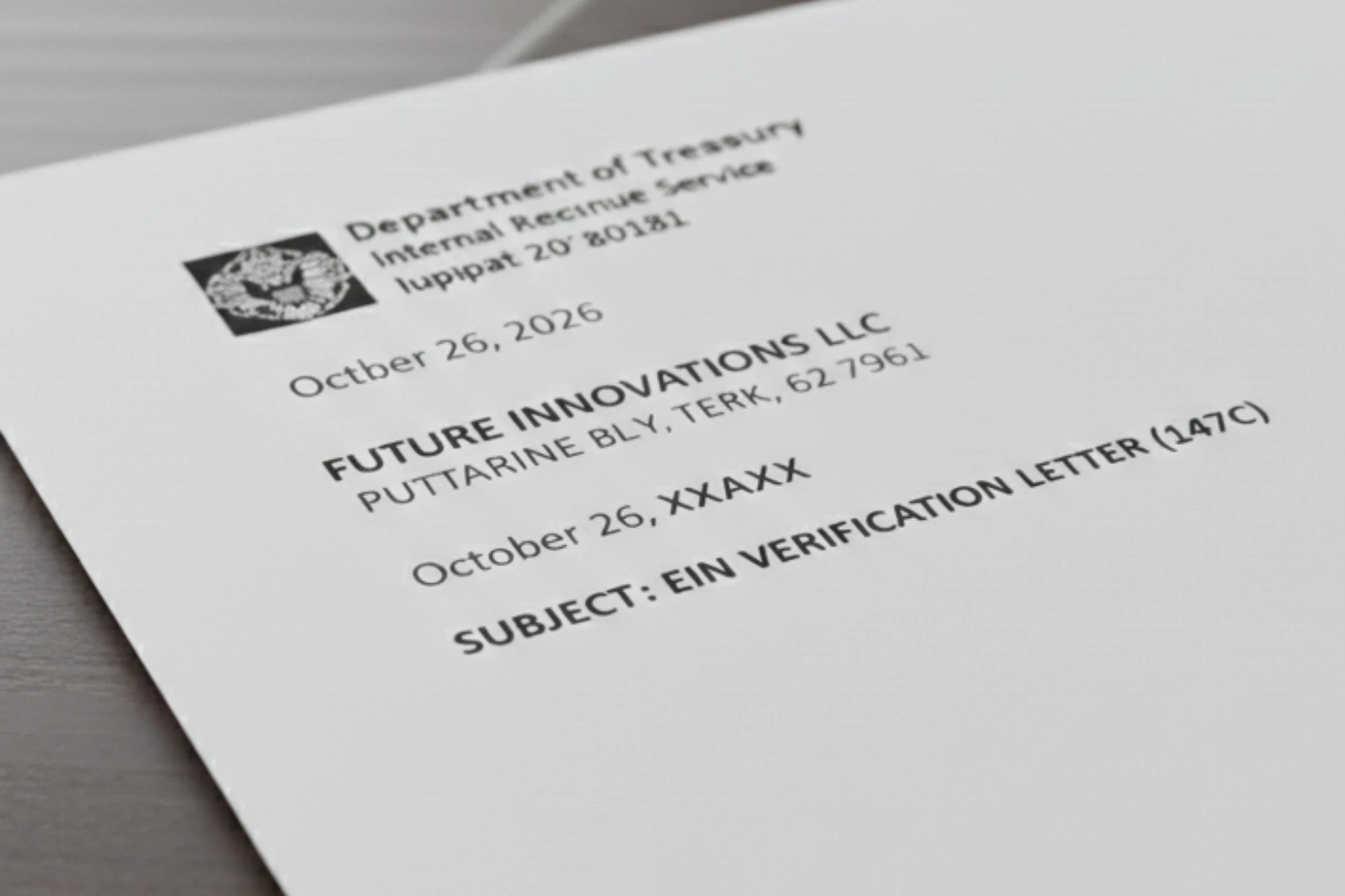
The name comes from the IRS internal letter number, and you will see the same document described as an EIN verification letter or, less commonly, a FEIN verification letter. All three refer to one thing: an official IRS statement that a specific EIN belongs to a specific legal entity.
The letter is short. It shows the legal name of the business as the IRS recorded it, the EIN itself, and the mailing address held in IRS records. That is the whole point of the document. It does not assign a number, it does not change anything about your tax account, and it does not certify that your business is in good standing with any state. It verifies a match between a name and a number.
That match is why third parties ask for it. When a bank, a payment processor or a payroll provider runs your EIN against IRS records, the legal name must line up character for character. A single difference — a missing "LLC", a comma, a shortened trade name — is enough to fail the check. The 147C letter shows exactly what the IRS has, which is the only version that matters in those systems. If you are still deciding what an EIN is or whether you need one at all, start with our guide on what an EIN is and how to get it.
147C Letter vs. CP-575
CP-575 is the one-time notice the IRS mails when your EIN is first assigned, and the IRS does not reissue it. The 147C letter exists precisely because that original notice cannot be replaced: it is the reissuable equivalent, and any institution that asks for a CP-575 will accept a 147C in its place. If you want the full comparison of the two documents, including what to do when a bank insists on the original, read our detailed guide to the EIN letter from the IRS.
When Do You Need an EIN Verification Letter?
The most common trigger is banking. Opening a US business bank account almost always requires documentary proof of the EIN, and if you never received or can no longer find the original notice, the 147C is what you hand over instead. Non-resident founders run into this constantly, and our walkthrough on opening a US business bank account as a non-resident covers the surrounding paperwork.
Payment processors are the second trigger. Stripe, PayPal and similar platforms verify the tax identity of the account holder before releasing payouts, and a name mismatch freezes onboarding until it is resolved. Our guide on setting up Stripe and PayPal with a US company explains where these checks usually break.
Beyond that, you will be asked for a 147C letter when you register a payroll provider, when you complete marketplace seller verification, when you register your company in an additional state, when a lender or merchant underwriter reviews your file, and when a mismatch has already caused a rejected filing or an information return that does not tie back to your account. Handing over a current 147C is faster than arguing about which version of your name is correct.
How to Request Form 147C From the IRS, Step by Step
1. Confirm You Are an Authorized Person
The IRS will only discuss an EIN with someone tied to the entity: a sole proprietor, a partner, a corporate officer, an LLC member or manager, a trustee, or a third party holding a valid authorization on file. If your accountant or agent is making the call for you, that authorization has to exist before the call, not during it. Without it the agent will end the conversation, no matter how much detail the caller can recite.
2. Gather Everything Before You Dial
Have the EIN itself if you know it, the exact legal name of the entity, the mailing address the IRS has on record, the type of entity, the approximate date the EIN was assigned, and your own name and title. If the address on file is outdated, expect friction: the agent compares what you say to what the system shows. Updating the responsible party or address is a separate filing, and doing it first saves a second call.
3. Call the IRS Busniess & Specialty Tax Line
Call the IRS Business & Specialty Tax Line and follow the prompts for EIN questions. Wait times swing wildly by season, so early in the day and mid-week is generally your best window. When you reach an agent, say plainly that you need a 147C letter — the term is standard and the request is routine.
4. Choose Fax or Mail Delivery
The agent will offer fax or mail. Fax is the option to take whenever you can: the letter typically arrives within minutes, often before the call ends, and you get a document you can forward to your bank the same day. Mail goes to the address of record only, which is a problem if that address is a former registered agent or an old office. The IRS will not email the letter and will not send it to an address other than the one on file.
How Long Does an IRS 147C Letter Take?
Fax is effectively immediate. Mail is measured in weeks, and international mail is slower still. If a bank or processor has given you a deadline, treat fax as the only realistic route and arrange a receiving number before you call. A digital fax service works fine for this, and it gives you a clean PDF instead of a paper copy you then have to scan.
Requesting a 147C Letter as a Non-Resident Owner
Founders outside the United States can request the letter the same way, with three practical differences. First, calls have to be made during US business hours through the international line for business callers rather than the domestic number. Second, you almost certainly need a digital fax number, because mail delivery to a foreign address is slow and the IRS may only send to the address of record anyway. Third, the details the agent verifies must match the entity as it was set up, which is where founders who formed a company remotely sometimes discover their address of record is still their formation agent.
You do not need a personal US tax identification number to request a 147C letter for your company. If you are weighing whether you need one for other reasons, our comparison of EIN and ITIN for non-residents explains where each is actually required, and our guide on getting an EIN as a non-resident business owner covers the application path itself.
Why Your 147C Request Gets Refused, and How to Fix It
There are four recurring reasons. The caller is not authorized, which is solved by filing the right authorization before calling again. The details do not match the IRS record, usually the legal name or the address, which means the correction has to be filed first. The responsible party on the account left the business years ago and was never updated, which is its own filing and worth doing regardless of the letter. Or the EIN in question was never actually assigned — the number being searched for belongs to a different entity or was never issued at all.
That last case is different from a lost document. If you cannot locate the number itself, work through our guide on finding a lost EIN number quickly first; if you had the notice and misplaced it, our article on a lost EIN confirmation letter walks through the recovery order.
Do Not Apply for a Second EIN
When the original notice cannot be found, the fastest-looking fix is to apply for a new EIN. It is the most expensive mistake in this whole process. A duplicate EIN splits your filing history across two accounts, causes information returns to mismatch, confuses payroll and state registrations, and takes far longer to unwind than a phone call would have taken. If your entity already has a number, verify it — do not replace it. Reviewing your original application details, covered in our guide to the SS-4 form, is usually enough to reconstruct what the IRS has on file.
After You Get Your 147C Letter
Save the PDF with a filename you will recognize a year from now, and store it with your formation documents rather than in an email thread. Check the legal name and address on the letter against what your bank and processors have; if they differ, fix the record now instead of during your next onboarding. And remember that the letter is not a scarce resource. It costs nothing and you can request another one whenever a counterparty needs a fresh copy.
Frequently Asked Questions
Is a 147C letter the same as an EIN verification letter?
Yes. They are two names for the same IRS document. Some banks also call it a 147C form or an IRS letter 147C.
Can I get a 147C letter online?
No. There is no online request, no self-service download, and no third-party portal that can generate one. The request is made by phone.
Will the IRS email my 147C letter?
No. The IRS delivers it by fax or by mail to the address on record. Any service claiming to email you an official copy is not sending you an IRS document.
Can my aaccountant or registered agent request it for me?
Only with a valid authorization already on file with the IRS. A verbal statement on the call is not sufficient.
Is there a fee for a 147C letter?
No. The letter is free. You may pay for a digital fax service, but the IRS charges nothing.
What if my business name has changed?
The letter reflects what the IRS has on record, so update the name with the IRS first. Otherwise you will receive a letter showing the old name, which defeats the purpose of the verification.
Gettin Your EIN Right From the Start
Most 147C requests trace back to the same root cause: an EIN that was applied for in a hurry, with an address or a responsible party that no longer reflects reality. If you are forming a US company or still waiting on your number, our EIN application service handles the filing and keeps your records consistent from day one — so the next time a bank asks for verification, it is a five-minute task instead of a two-week detour.
This article is general information, not tax advice. IRS procedures, phone hours and delivery times change; confirm current details with the IRS or a qualified tax professional before acting.

Begüm Tekin
Tax Operations Manager at Clemta